
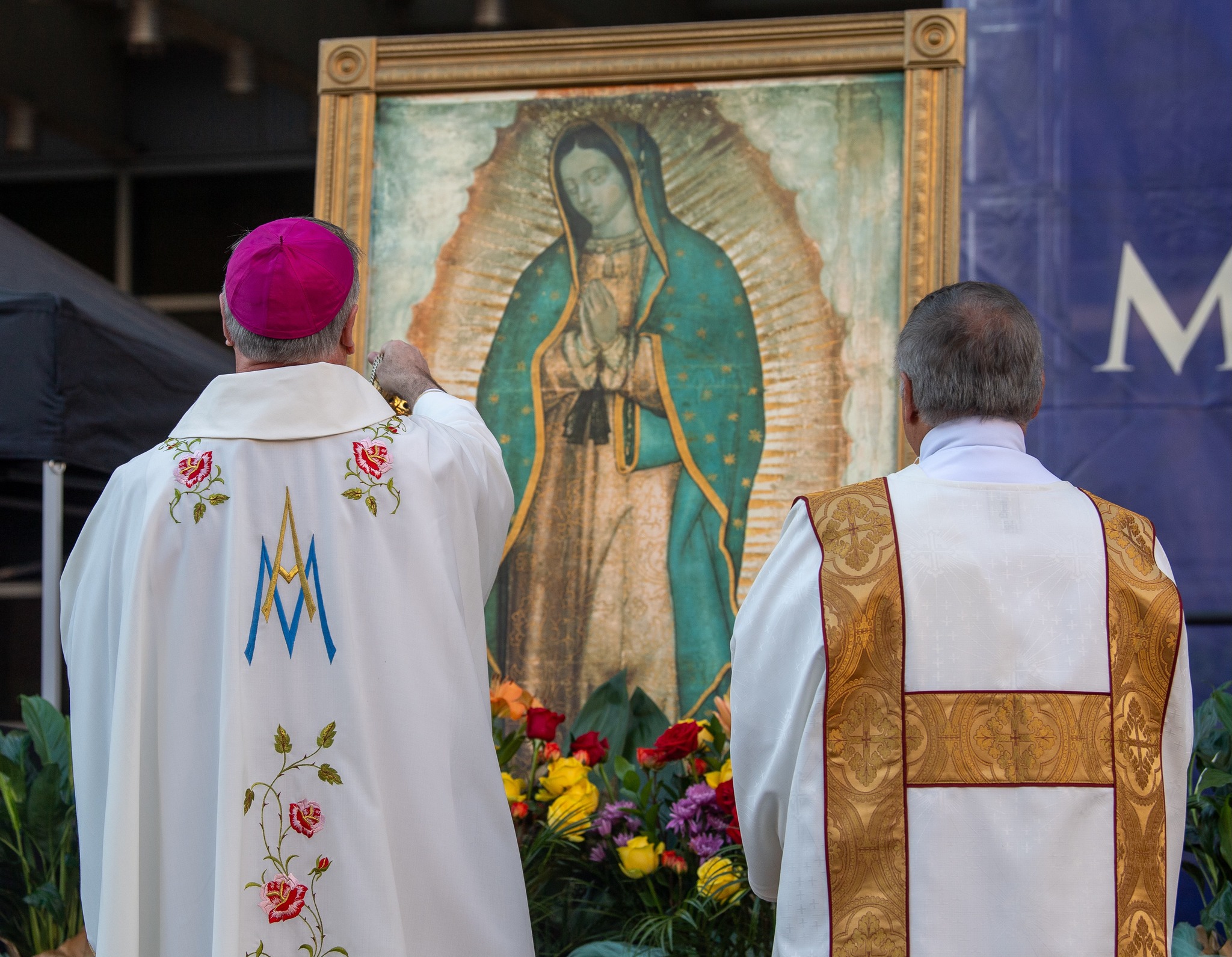
The First Apparition of Our Lady of Guadalupe
Below is a revised and edited translation of a portion of Nican Mopohua, the original account of the apparitions of Our Lady of Guadalupe.
Fr. John Nahrgang, a specialist in Our Lady of Guadalupe from the Diocese of Phoenix, is the translator. Here you will find his translation of the introduction and the first apparition.
The original text is from the official website of the National Basilica of Our Lady of Guadalupe in Mexico City.
Introduction and First Apparition
Here is told and set down in order how a short time ago the Perfect Virgin Holy Mary Mother of God, our Queen, miraculously appeared out at Tepeyac, widely known as Guadalupe. First she caused herself to be seen by a humble indigenous man named Juan Diego, poor but worthy of respect; and then her precious image appeared before the recently named bishop, Don Fray Juan de Zumárraga.
Ten years after the City of Mexico was conquered, with the arrows and shields put aside, when there was peace in all the towns, just as it sprouted, faith now grows green, now opens its corolla, the knowledge of the Giver of life, the true God.
At that time, the year 1531, a few days into the month of December, it happened that there was a humble but respected Indian. His name was Juan Diego, and he lived in Cuauhtitlán, as they call it. And in matters of religious teachings, he belonged to Tlatelolco.1
It was Saturday, not yet dawn, and he was going there the pursuit of learning about God and His commandments. And as he drew near the little hill called Tepeyac it was beginning to dawn. He heard singing on the little hill, like the song of many precious birds; when their voices would stop, it was as if the hill were answering them. Extremely soft and delightful, their songs surpassed those of the coyoltototl and the tzinitzcan and other precious songbirds.2
Juan Diego stopped to look. He said to himself, “By any chance am I worthy, have I deserved what I hear? Perhaps I am only dreaming it? Perhaps I’m only dozing? Where am I? Where do I find myself? Is it possible that I am in the place of which our ancient ancestors, our grandparents, spoke? Am I in the land of the flowers, the land of corn, of our flesh, of our sustenance, perhaps the land of heaven?”
He was looking up toward the top of the hill, toward the direction in which the sun rises, from where the precious heavenly song was coming.
And then when the singing suddenly stopped, when it could no longer be heard, he heard someone calling him from the top of the hill; someone was saying to him, “Juan, dearest Juan Diego.”
Then he dared to go to where the voice was coming from, his heart was not disturbed and he felt extremely happy and contented; he started to climb to the top of the little hill to go see where the call was coming from. When he reached the top of the hill, a Maiden was standing there. She called to him to come close to her.
And when he reached where she was, he was filled with admiration for the way her perfect grandeur exceeded all imagination: her clothing was shining like the sun, as if it were sending out rays. And the rock, the crag on which she stood, seemed to be giving out rays, their radiance like a precious turquoise bracelet. The earth seemed to shine with the brilliance of a rainbow in the mist. And the mesquites, prickly pear, and the other little plants that are generally up there seemed like jade, their foliage like turquoise. And their trunks, their thorns, their prickles, were shining like gold.
He prostrated himself in her presence. He listened to her voice (breath), her words, which were very pleasing, as if from someone who was drawing him toward her and esteemed him highly. She said to him: “Listen my dearest and youngest son, Juan; where are you going?” And he answered her: “My Lady, my Queen, my Little Girl, I am going as far as your little house in Mexico Tlatelolco, to follow the things of God that are given to us given, that are taught to us by those who are images of the Lord: our priests.”
Then she said to him, revealing her precious will: “Know, know for sure, my dearest and youngest son, that I am truly the ever-perfect Holy Virgin Mary, venerable Mother of the one true God, the Giver of Life, the Creator of peoples, the Lord of that which is all around us and close to us, the Lord of Heaven, the Lord of Earth.
“I greatly desire that my sacred little house be built here, in which I will show Him, I will exalt Him upon making Him manifest, I will give Him to the people in all my personal love; He who is my compassionate gaze, He who is my help, He who is my salvation. Because I am truly honored to be your compassionate mother, yours and of all the peoples that live together in this land, and of all the other peoples of different ancestries: those who love me, those who cry to me, those who seek me, those who trust in me. Because there [at my sacred house] I will listen to their cries and sadness to remedy, to cure their various troubles, miseries and sufferings.
“But in order to accomplish what I have chosen to do, go to the residence of the Bishop of Mexico and tell him how I have sent you, so that you may reveal to him how I very much want him to build me a sacred little house here, to erect my temple on the plain; tell him everything, all you have seen and marveled at, and what you have heard. And know for sure that I will appreciate it very much and reward it, that because of it I will enrich your life, you will flourish; and because of it you will be very deserving of how much I will reward your fatigue for taking on this important matter for which I am sending you. Now, my dearest son, you have heard my breath, my word; go, do that for which you are responsible.”
And immediately he prostrated himself in her presence, and he said to her: “My Lady, My Little Girl, now I am going to make your venerable breath, your venerable word, a reality; I, your poor servant, take leave of you for a while.”
1 This is a reference to the Church of Santiago Tlatelolco, where the Franciscan missionaries also provided catechesis.
2 The literal translation of coyoltototl is “jingle bell bird.” The term can refer to either the red-winged or yellow-headed blackbird, both of which sing a pleasant song like that of a bell. The tzinitzcan refers primarily to the colorful Mexican trogon