
The Synod of Young Adults for the Diocese of Phoenix
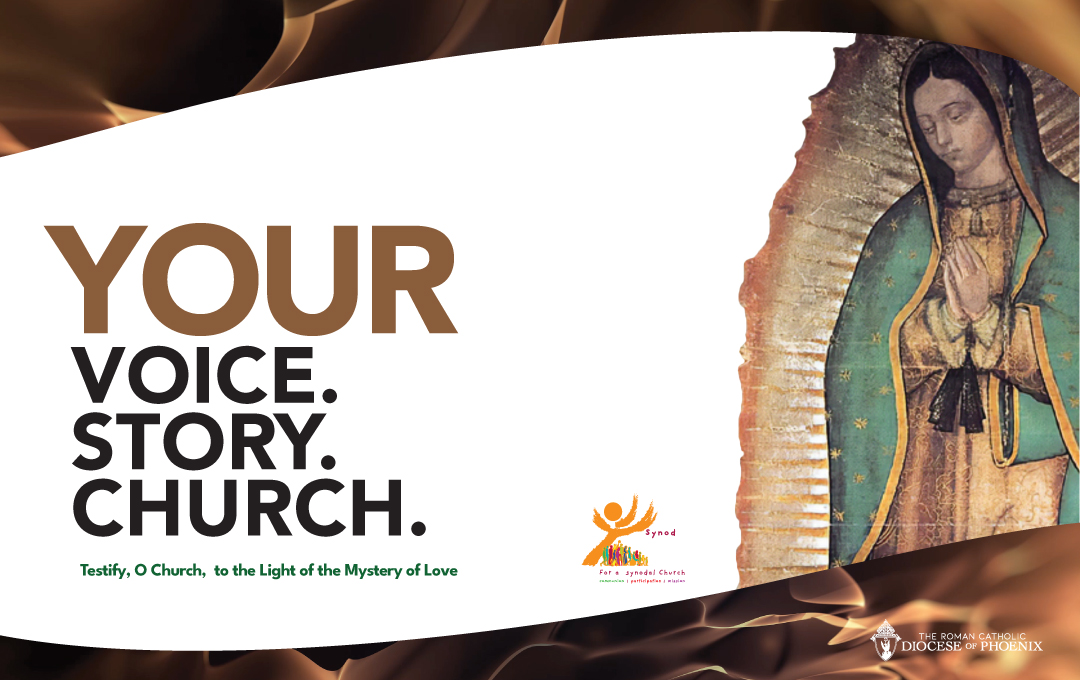
The Synod of Young Adults was convoked in April 2025 by Bishop John P. Dolan as a central initiative of TILMA, his seven-year pastoral plan for evangelization (2025–2031), inspired by Our Lady of Guadalupe and inaugurated during the Jubilee Year of Hope. Rooted in Pope Francis’ call to be “pilgrims of hope,” the Synod sought to listen attentively to young adults and discern how the Church can more effectively accompany them in matters of faith, vocation, marriage, family life, and mission.
On April 12th 2025, Bishop John Dolan convoked The Synod of Young Adults as a central initiative of TILMA, his seven-year Diocesan pastoral plan for evangelization through the year 2031, inspired by Our Lady of Guadalupe and inaugurated during the Church’s Jubilee Year of Hope. Rooted in Pope Francis’ call to be “pilgrims of hope,” the Synod sought to listen attentively to young adults and discern how the Church can more effectively accompany them in matters of faith, vocation, marriage, family life, and mission — and how they, as young adults, can participate in their mission of evangelization.
From August to November of this past year, the Diocesan Synod Preparatory Commission scheduled 80 Synodal Listening Sessions in parishes, Newman Centers and other locations across the Diocese. Nearly 1,000 young adults allowed their voices to be heard — giving their input in the listening sessions using the “Conversations in the Spirit” model, as well as through an online survey in the final weeks of November. Over 230 pages of qualitative data were collected in this effort. In early December, the Synod Commission met for two days to prayerfully review and synthesize the raw data, ensuring fidelity to the voices of participants. Artificial Intelligence was also employed by the Commission to help collate the data, so as to avoid any personal biases. The Report for the 2025 Synod of Young Adults is the result of this multi-stage process.
On February 14th 2026, more than 100 people came together in a Synod Assembly to review the Report and recommend pastoral actions to implement the findings of the listening sessions. The following day, during the 9:00AM Mass at Ss. Simon and Jude Cathedral, Bishop John entrusted copies of the Report — along with the input of the Synod Assembly — to the Chairpersons of the Diocesan Pastoral Council and the Presbyteral Council (Priests’ Council). The two councils will now discern an action plan based on all that they have received from the Synod. Finally, the recommendations of the action plan will go to Bishop John and Diocesan leadership to determine an implementation strategy and timeline for the action plan.
We thank everyone who gave of their time, their hearts and their prayer through planning and participating in the listening sessions, survey, and feedback on the Report — and we look forward to sharing the action plan and timeline to be developed to shape ministry with young adults in our Diocese.
The Goal of the Synod of Young Adults flows from Year One of the 7-year Diocesan Pastoral Plan, TILMA, and has a three-fold purpose:
First:
To foster a culture of evangelization that will engage young adults on relevant issues, and then work with them to engage others in the years ahead;
Second:
To respond in a practical and impactful way to two of the ten “hopes” that Pope Francis has articulated for this Jubilee Year, namely:
- Hope for Openness to Life and Responsible Parenthood
- Hope for Youth and Young Adults
Third:
To begin a more deliberative process of evangelization in parishes – starting with young people, including those who have left the Church and those who might consider themselves “on the margins” or “nones.”
Synod of Young Adults begins next stage
Read the full articleYoung adults gather for historic training, Diocese looks toward impact on Church
Read the full article
This program is made possible, in part, through a Vital Worship, Vital Preaching Grant from the Calvin Institute of Christian Worship, Grand Rapids, Michigan — with funds provided by Lilly Endowment Inc.
Frequently Asked Questions
A Synod is a gathering of the faithful to listen to what the Holy Spirit is saying to the Church and asking her to be and to do. This gathering can involve the faithful in different ways: pastors with lay people, bishops with the other ordained ministries, pope with bishops, etc.
Pope Francis calls it “an exercise of mutual listening, conducted at all levels of the Church and involving the entire People of God” (Pope Francis, 18 September 2021). It involves encounter, listening and the discernment of spirits.
The word synod comes from the Greek synodos, which has the general meaning of “walking together.” It offers an image of the Church as a pilgrim people, growing and developing on a journey of faith; a very different image from that of the Church as a static institution. A synodal Church expresses the Second Vatican Council vision of what sees the Church called to be: the People of God in which all baptized share the same dignity, and the essential distinction between lay people, clergy, bishops etc. is a difference of vocation and role, not of superiority.
Synods taken many forms in church history and they are currently practiced in the Church at all levels: from parish Pastoral Council meetings to Diocesan Synods, from Provincial Councils to Plenary Councils, from the assembles to the Synod of bishops to ecumenical Councils in which the bishops from across the world gather in Rome with the Pope. The practice of gathering to listen to the Spirit is as old as the Church herself, as shown by the “Council” of Jerusalem described in Acts of the Apostles 15. Synod-type mechanisms (listening, dialogue, discernment, deliberation) have always been used in monasteries and religious houses when making decisions. The conclaves, when cardinals meet to elect the new pope, is a synod event.
Pope Francis has sought from the beginning of his pontificate up to his death in April 2025 to invigorate and reconfigure the Synod of Bishops so that it might become more of an exercise of listening and discernment. Ever since his election in 2013, he has been teaching the Church about synodality and encouraging us to become a more synodal Church at every level. In an important speech on 17 October 2015, he said that the path of synodality is what God expects of the Church in the third millennium.
Pope Leo XIV, since his election as our Holy Father on May 8th 2025, has — on numerous occasions — voiced his determination to carry on this legacy of Pope Francis: Synodality… “is to help the Church fulfill its primary role in the world, which is to be missionary, to announce the Gospel… Synodality is not a campaign. It’s a way of being and a way of being Church”
Synodality is a style, a culture, a way of thinking and being, that reflects the truth that the Church is led by the Holy Spirit who enables everyone to offer their own contribution to the Church’s life. This synod process seeks to “strengthen cooperation” in all areas of the Church’s mission, to enhance communion, participation and mission.
While “Synodality is an expression of the Church’s nature, her form, style and mission”(Pope Francis, 18 September 2021), the Church in our day lacks the habit and practice of synodality. This is what Pope Francis invites us to examine and discern for the future.
Synodality is also reflected in a synodal style of governance, in which people participate in decision making, share responsibility for the Church’s mission , and cooperate and collaborate more in the day-to-day life of the Church. Some call this “co-responsibility.” Church is neither a monarchy nor a democracy. Pope Francis has made clear that the synod is not a parliament, or a convention, or an opinion survey. Although it has many elements familiar to political and similar processes – listening, speaking, taking votes – what differentiates a Synod is that it is a spiritual process that takes place within the Church. “The Synod is an ecclesial event, and its protagonist is the Holy Spirit. If the Spirit is not present, there will be no Synod” (Pope Francis, 09 October 2021).
Pope Leo, like Pope Francis, has clarified that synodality does not diminish the authority of the Pope, bishops and priests but rather enhances co-responsibility for the mission of the Church, with the faithful collaborating in charting the Church’s direction. Synodality is a way of de-centralizing and sharing decision-making while maintaining the Church’s doctrinal integrity.
Pope Francis has stressed on several occasion the need for the Synod to involve everyone, and to reach out as much as possible. “Everyone has a part to play; no one is a mere extra … The Synod is for everyone, and it is meant to include everyone … Let everyone come in … the Holy Spirit needs us. Listen to him by listening to each other. Leave no one behind or excluded.” (Pope Francis, 18 September 2021).
He stresses “real involvement on the part of each and all” and “a way of acting marked by true participation…. Enabling everyone to participate is an essential ecclesial duty! All the baptized, for baptism is our identity card.” (Pope Francis, 09 October 2021).
The Diocese of Phoenix “Synod of Young Adults” has involved Synodal Listening Sessions to which all the young adult-baptized (ages 18-39) are explicitly invited to participate, especially within their local communities; no one is excluded. The Synod Preparatory Document and the Vademecum have also stressed the importance of reaching out to the poor, to those who have less of a voice. This is also true of parishes, who must ensure that those people who might not normally attend meetings can be heard.
Because this way of proceeding is not the usual way the Church operates, Pope Francis is explicit in saying this involves a change or conversion. “In this regard, we have taken some steps forward, but a certain difficulty remains, and we must acknowledge the frustration and impatience felt by many pastoral workers, members of diocesan and parish consultative bodies and women, who frequently remain on the fringes.”(Pope Francis, 09 October 2021)
Clericalism poses an obstacle to participation; such an attitude of rigidity and superiority prevents us from recognizing the mission of each of the baptized in the Church. “One of the ills of the Church, indeed a perversion, is the clericalism that detaches priests and bishops from people, making them officials, not pastors. There can be no discrimination in the name of God. Discrimination is a sin among us too, whenever we start to say: “We are the pure, we are the elect, we belong to this movement that knows everything, we are…” No! We are the Church, all of us together.” (Pope Francis, 18 September 2021).
“Being a synodal Church means being a Church that is the sacrament of Christ’s promise that the Spirit will always be with us.” (Pope Francis, 18 September 2021).
Becoming a synodal Church transforms the Church more authentically. For Pope Francis, this change requires mindset and cultural conversion and leads to structural adjustments. He describes it as “moving structurally towards a synodal Church, an open square where all can feel at home and participate” (Pope Francis, 09 October 2021).
The Pope describes this becoming a synodal Church as an opportunity to become a “listening Church” and a Church of “closeness, compassion and tender love” which better reflects the “style of God”. (Pope Francis, 09 October 2021).
The purpose of any synod or synodal listening session is not to collect everyone’s individual opinions, but rather to hear what the Holy Spirit is saying to us through our prayers and reflections. Listening to each other is very important. Pope Francis has said that during the Synod of Bishops gathering: “We listen, we discuss in groups but above all we pay attention to what the Spirit has to say to us.” This discernment is not an activity done in isolation. Mutual listening and reflection are vital, as what is proposed grows from the unity and conviction that comes from the lived practice of faith within the community.
The process of spiritual discernment calls for everyone’s participation. The Church asks everyone to be open to the Holy Spirit, to discern where the local Church is being led in its own context. The Church asks bishops to listen carefully to the views of the faithful and asks the faithful to respect the authentic role of the bishop as one who governs the local Church and promotes communion. Discernment is always oriented towards the mission of the universal Church which continually moves towards Christ, the Way, the Truth, and the Life, who calls his people into a unity of purpose.
Pope Francis says: “what is under discussion at synodal gatherings are not the traditional truths of Christian doctrine. The Synod is concerned mainly with how teaching can be lived and applied in the changing contexts of our time.” Therefore, all topics can be raised, but it is important to realize that not all topics will form part of the ongoing discussion.
Pope Leo, like Pope Francis, has clarified that synodality does not diminish the authority of the Pope, bishops and priests but rather enhances co-responsibility for the mission of the Church, with the faithful collaborating in charting the Church’s direction. Synodality is a way of de-centralizing and sharing decision-making while maintaining the Church’s doctrinal integrity.
The synodal process is not about a democratic debate. It is place of respectful mutual listening and experiencing the call of the Holy Spirit to move in new ways. Again, the Pope is clear on this: “Another temptation that so often confuses people is treating the synod as a kind of parliament underpinned by a ‘political battle’ in which in order to govern one side must defeat the other…this goes against the spirit of the synod as a protected space of community discernment.”
What the synodal process will do is embed at all levels of the Church a new way of listening and hearing, of discernment and action, which remains faithful to the truths received but expresses them in the context of a particular time.
In October 2024, Bishop Dolan wrote the Diocese of Phoenix a Pastoral Letter entitled “TILMA,” inspired by the acronym Testifica, oh Iglesia, a la Luz del Misterio del Amor (Testify, o Church, to the Light of the Mystery of Love). Looking to Our Lady of Guadalupe, the patroness of the Diocese of Phoenix, the bishop has created a seven-year pastoral plan on evangelization, leading up to December 2031, the 500th anniversary of Our Lady of Guadalupe appearing to St. Juan Diego on Tepeyac Hill in modern day Mexico City. In the Pastoral Plan where he launched the idea of holding a Synod of Young Adults in 2025.
The Synod of Young Adults began on April 12, 2025 with a prayer service and training of young adult Synodal Leaders. These young adult leaders will then facilitated Synodal Listening sessions in parishes and other locations throughout the Diocese of Phoenix from late August to the end of November. The results of the listening sessions have now been gathered and — with the help of artificial intelligence to avoid bias — a preliminary Synod Report has been prepared. On February 14th 2026, representatives from around the Diocese will gather in a Synod Assembly to prayerfully discern the findings of the Synod Report and present the Final Synod Report to Bishop Dolan. The Bishop, along with his major advisory councils and Diocesan leadership, will then determine — from the results of the input from the young adults what action steps will be taken to support evangelization efforts in the Diocese. Action steps that will support the evangelization effort in the diocese.